The surrender of German forces on Lűneberg Heath in May 1945 marked one of the final acts of the Second World War, the unconditional surrender of German forces in northwest Europe.
By early May, the German situation was desperate; the Western Allies had taken much of western Germany, Soviet forces were besieging Berlin and Hitler had committed suicide, appointing as his successor Groẞadmiral Karl Dӧnitz.
In a bid to negotiate a partial surrender in the west while continuing the fight against the Soviets, a delegation headed by Dӧnitz’s deputy, Admiral Hans-Georg von Friedeberg, accompanied by General Eberhard Kinzel and Rear Admiral Eberhard Wagner, crossed into the British lines north of Hamburg at 0800h on the morning of 3 May.
The German leadership was aware from captured documents of the proposed postwar division of Germany and wished to enable as many German soldiers and civilians to escape the advancing Red Army by a series of local surrenders to buy time for this to happen.
The delegation was escorted to the Headquarters of Gen. Miles Dempsey, GOC British 2nd Army. The three senior German Officers plus an aide, Major Freidel, were then taken to the TacHQ of Field Marshal Bernard Montgomery, GOC 21st Army Group on the Timloberg, an area of high ground on Lűneberg Heath.
Having been made aware of the delegation’s arrival, Montgomery kept them waiting in the open under a Union Jack on a flagpole. He then emerged from his famous caravan and asked through an interpreter, “Who are these men?” When given the answer, he replied, “Well I’ve never heard of them. What do they want?”
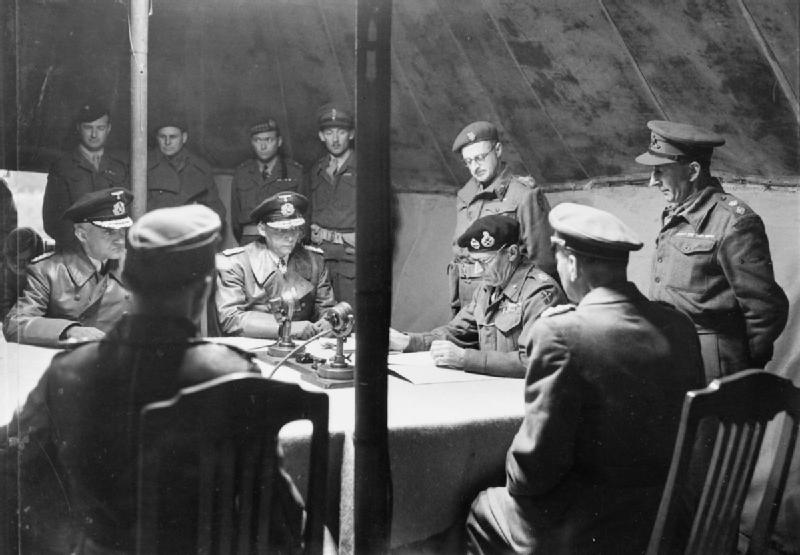
The negotiations were brief and to the point; Montgomery would accept nothing but unconditional surrender. An attempt by Admiral von Friedeberg to present a letter from General Keitel, Head of the Army, offering the British the surrender of Army Group Vistula, then deployed north of Berlin and certain to fall into Soviet hands, was turned down flat.
Von Friedeberg and his team felt that they did not have the authority to make the necessary decisions, so he, accompanied by Maj. Friedel, returned to consult with Dӧnitz. On their return the following afternoon and faced with no alternative, the German delegation agreed to the surrender of all German forces in the Netherlands, Denmark and northwest Germany.
The signing of the surrender document took place in a carpeted tent on the heath at 1830h that evening.
Coming into force the following morning, this paved the way for the full surrender, signed at Reims on 7 MY and ratified in Berlin on 8 May – the day now known as VE Day.
The Lűneberger Heide capitulation put an immediate end to the fighting across northwest Europe and the end of occupation for areas that had been under Nazi oppression since 1940. This also meant that aid could flow to the civilian population, particularly the people of the Netherlands who had endured the brutal “Hunger Winter” of 1944-45.
A stone memorial to the signing of the surrender was installed at the spot but was repeatedly vandalised and was removed in 1958 to the grounds of the Royal Military Academy, Sandhurst.