Prior to this the German ‘Kaiserschlacht’ (the Kaiser’s Battle) series of offensives running from 21st March to 18th July had driven the Allies back up to 65km (40mi), their greatest advance of the war. The German Army advanced right to the outskirts of Ypres and, on the Somme the town of Albert, which had been behind the British lines the whole war, fell to the enemy.
This was an attempt to defeat the British and French armies before the USA could decisively enter the war. It failed because of lengthening supply lines and heavy casualties – around 700,000 – particularly amongst the elite Stoẞtruppen.
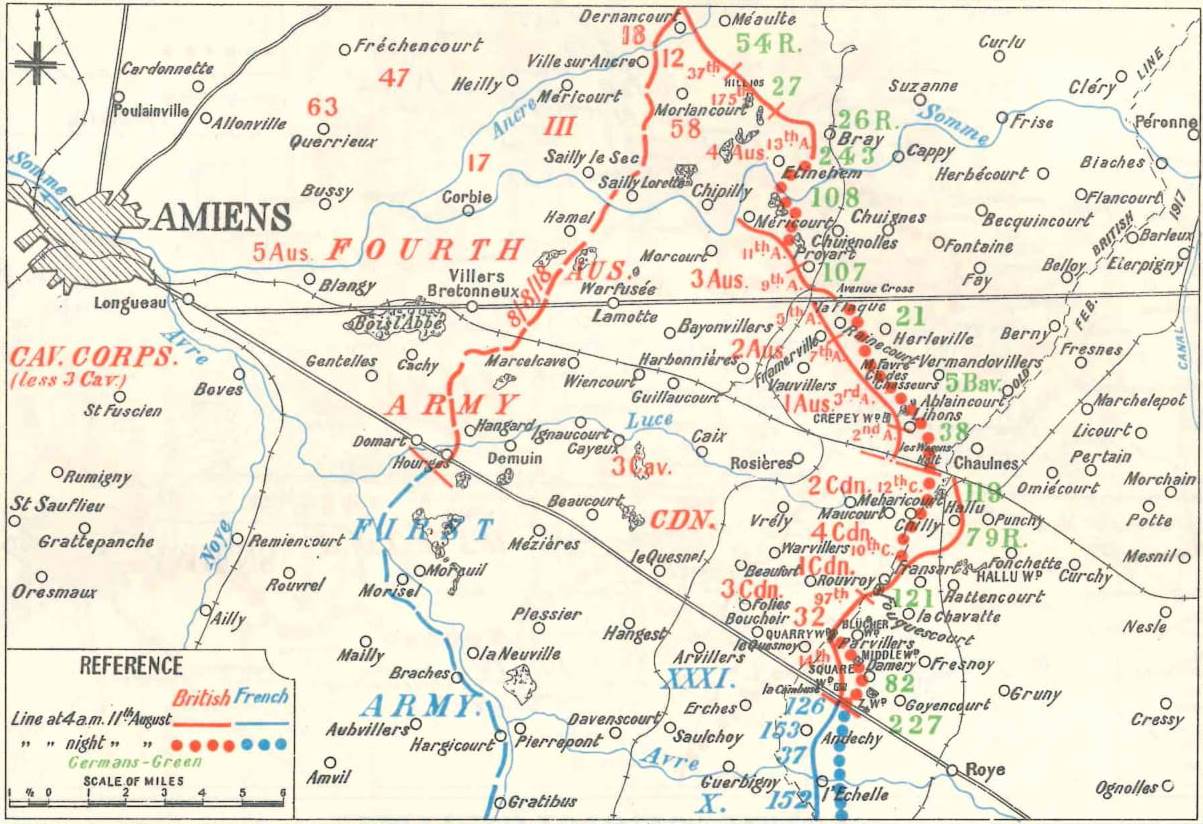
With the Kaiserschlacht offensive now fought to a standstill, Allied preparations began to push the enemy back.
General Henry Rawlinson’s British 4th Army, including five Divisions from Lt. Gen. Monash’s Australian Corps and four from Lt. Gen. Arthur Currie’s Canadian Corps, would spearhead the attack on the German 2nd Army opposite Amiens, alongside Gen. Marie Eugene Debeny’s 1st French Army.
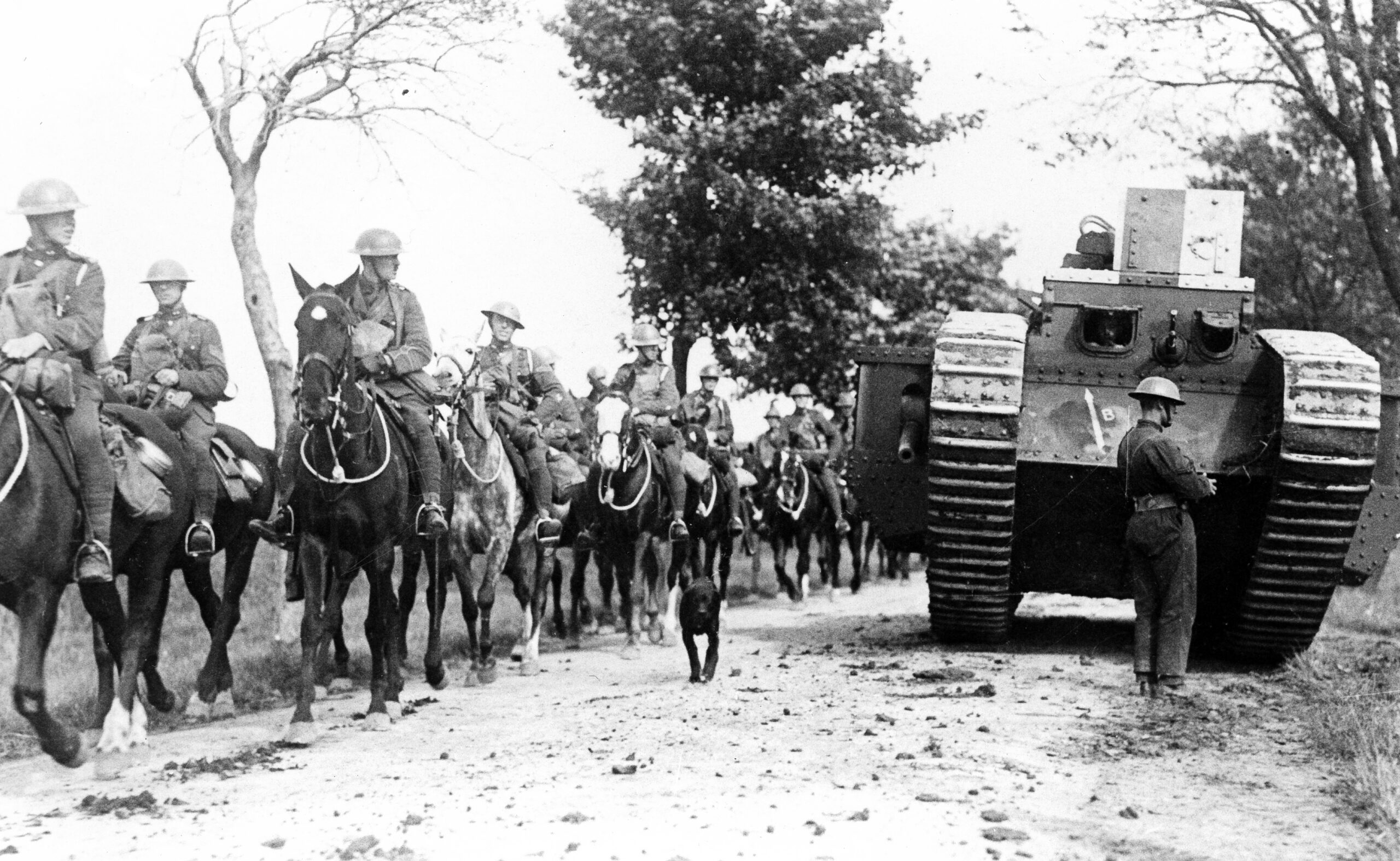
The plan, drawn up by Monash, called for a combined arms assault involving tanks, infantry, and aviation assets backed by a lightning barrage rather than the usual long bombardment. The Cavalry Corps, commanded by Lt. Gen. Charles Kavanagh and accompanied by Medium Mark A Whippet tanks, would then exploit the breach.
The lightning bombardment coupled with the mass use or armour, was vital to achieve total surprise and had been tested successfully by Monash during the Battle of Hamel on 4th July.
To maintain secrecy, the Canadian Corps had been moved to Amiens covertly shortly in early August along with a force of over five hundred tanks.
These included 108 of the new Mk. V Heavy Tanks, 36 Mk.V* infantry carriers, 48 Whippets to accompany the Cavalry Corps and 24 unarmed supply tanks.
Enemy artillery was located by sound ranging, flash spotting and aerial reconnaissance to avoid the use of ranging shots by the artillery. Allied artillery comprised 1,390 field guns and howitzers plus almost 700 heavy guns.
The offensive opened at 0420h on 8th August in conditions of dense fog, which both aided surprise and added to confusion. The German First Position was captured by 0730, the rear of the enemy lines was secured by 1015 and cavalry pushed through to continue the advance.
French forces captured the town of Moreuil by 0930.
The Allies had advanced 11-13km (7-8 miles) on the first day for 12,000 casualties while inflicting 27,000 enemy casualties including 15,000 prisoners.
The advance continued more slowly on the 9th, although the US 33rd Infantry secured the strategically important Chipilly Ridge.
Fighting at Amiens would continue until 12th August, with the enemy steadily giving ground.
The German Army was exhausted and a steady collapse in morale took place after Amiens. General Ludendorff described 8th August as ‘the black day of the German Army’.
The Hundred Days offensive would continue with the Allies advancing up to 100km. Germany sued for an Armistice which was signed at 1100 on 11th November 1918.